
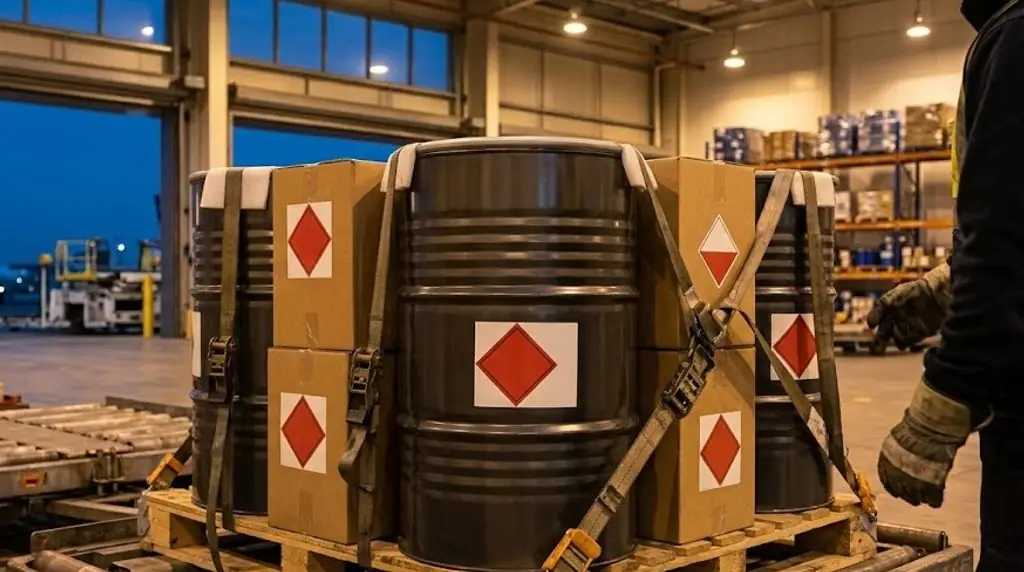
Shipper's Declaration for Dangerous GoodsShipper's Declaration for Dangerous Goods: the fields.
The Shipper's Declaration for Dangerous Goods is the signed form in which a shipper certifies that dangerous cargo is correctly classified, packed, marked and labelled for transport. Airlift Logistics, a freight forwarder in Dubai, explains the fields on the IATA air form, who must sign it, how the sea declaration under the IMDG Code differs, and the mistakes that get shipments rejected at acceptance.
The fields on the IATA form
Every box must be complete and match the packages. Handwritten or electronic forms are used.
| Field | What to enter |
|---|---|
| Shipper and consignee | Full names and addresses |
| Air waybill number | The 11-digit number, if known at the time |
| Airport of departure and destination | Names or IATA codes |
| For example UN1950 | |
| Proper shipping name | The official name, not a trade name |
| Class or division | Hazard class 1 to 9, with any subsidiary hazard |
| Packing group | I, II or III, where one applies |
| Quantity and type of packing | Number of packages, packing type and net quantity each |
| Packing instruction | The instruction number from the regulations |
| Passenger and cargo aircraft or cargo aircraft only | Strike out the one that does not apply |
| Emergency contact | A 24-hour telephone number |
| The shipper's signatory |
A guide to the main fields. Follow the current edition of the IATA Dangerous Goods Regulations for the exact form.
Who signs and who checks
The shipper is legally responsible for the declaration, not the forwarder or the airline.
- 01
The person signing must have dangerous goods training that is valid for the mode.
- 02
Forwarder checks
The forwarder checks the form and packages, but cannot correct the shipper's classification.
- 03
The airline checks the form and packages again before loading, and can refuse the cargo.
- 04
Match the labels
Package marks, labels and the form must all show the same UN number and name.
- 05
Copies
Usually two or more copies: one for the carrier and one kept by the shipper.
- 06
Start early
Send the SDS and draft declaration to your forwarder before booking space.
Air form vs sea declaration
For sea cargo, the same information appears on the Dangerous Goods Declaration under the IMDG Code.
| Point | Air (IATA DGR) | Sea (IMDG Code) |
|---|---|---|
| Shipper's Declaration for Dangerous Goods | Dangerous Goods Declaration | |
| Mode instruction | Passenger or cargo aircraft only | Vessel and voyage details |
| Extra data | Packing instruction numbers | Flash point, marine pollutant mark, EmS |
| Container packing | Not applicable | Container packing certificate when packed in a container |
| Signed by | Shipper | Shipper |
| Training | IATA DGR training | IMDG Code training |
Dangerous goods declaration questions, answered
Last updated ·
See all shipping questionsAsk a freight questionThe shipper signs, or a trained person acting for the shipper. By signing, the shipper certifies that the goods are correctly classified, packed, marked and labelled. The forwarder and airline check the form, but the responsibility stays with the shipper.
- Training must be current.
- Corrections need re-signing.
Often yes. Lithium batteries packed on their own, such as UN3480, need a full declaration. Some batteries packed with or in equipment follow lighter rules. The exact requirement depends on the type and the quantity, so check before booking air cargo.
- Our lithium page has details.
- Test summary may be needed.
The Dangerous Goods Declaration under the IMDG Code. It shows the same UN number, proper shipping name, class and packing group, plus marine pollutant and flash point data where they apply. A container packing certificate is added when goods are packed into a container.
- Sea and air forms differ.
- Both are signed by the shipper.
Several small errors. Common ones are a wrong UN number, a trade name for the proper shipping name, a wrong packing group, no emergency number and no signature. Labels that do not match the form also cause rejection at the airline or terminal.
- Check against the SDS.
- Struck-out fields must be clear.