

Lithium battery shipping in Dubai, UAELithium batteries, shipped by the rules.
Airlift Logistics handles lithium battery shipping in Dubai, UAE, as a dangerous goods freight forwarder in Dubai Airport Free Zone. We check the UN number (UN3480, UN3481, UN3090 or UN3091), watt-hour rating, state of charge, UN 38.3 test summary and packaging against the IATA Dangerous Goods Regulations 2026, then book a suitable airline from DXB or DWC.
Which UN number is your battery?
The UN number depends on two things: the chemistry (lithium ion or lithium metal) and how the battery travels (alone, packed with equipment, or inside equipment).
| UN number | What it covers | Packing instruction | Passenger aircraft? |
|---|---|---|---|
| UN3480 | Lithium ion batteries shipped on their own, such as power banks and spare packs | PI 965 | No, cargo aircraft only |
| UN3481 | Lithium ion batteries packed with equipment, or contained in equipment | PI 966 or PI 967 | Yes, within limits |
| UN3090 | Lithium metal batteries shipped on their own, such as coin cells | PI 968 | No, cargo aircraft only |
| UN3091 | Lithium metal batteries packed with or contained in equipment | PI 969 or PI 970 | Yes, within limits |
Sodium ion batteries now have their own entries, UN3551 and UN3552. Vehicles and e-bikes with batteries move under UN3171 or UN3556. Ask us before booking these.
The rules that stop shipments
Most rejected battery bookings fail on one of these points. We check each one before the cargo reaches the airline.
- 01
UN3480 at 30% or less. From 1 January 2026 this also applies to batteries packed with equipment (PI 966).
- 02
Every cell and battery type must have passed UN 38.3. The manufacturer supplies the test summary.
- 03
Cells up to 20 Wh and batteries up to 100 Wh can use the smaller-quantity rules. Larger ones are fully regulated.
- 04
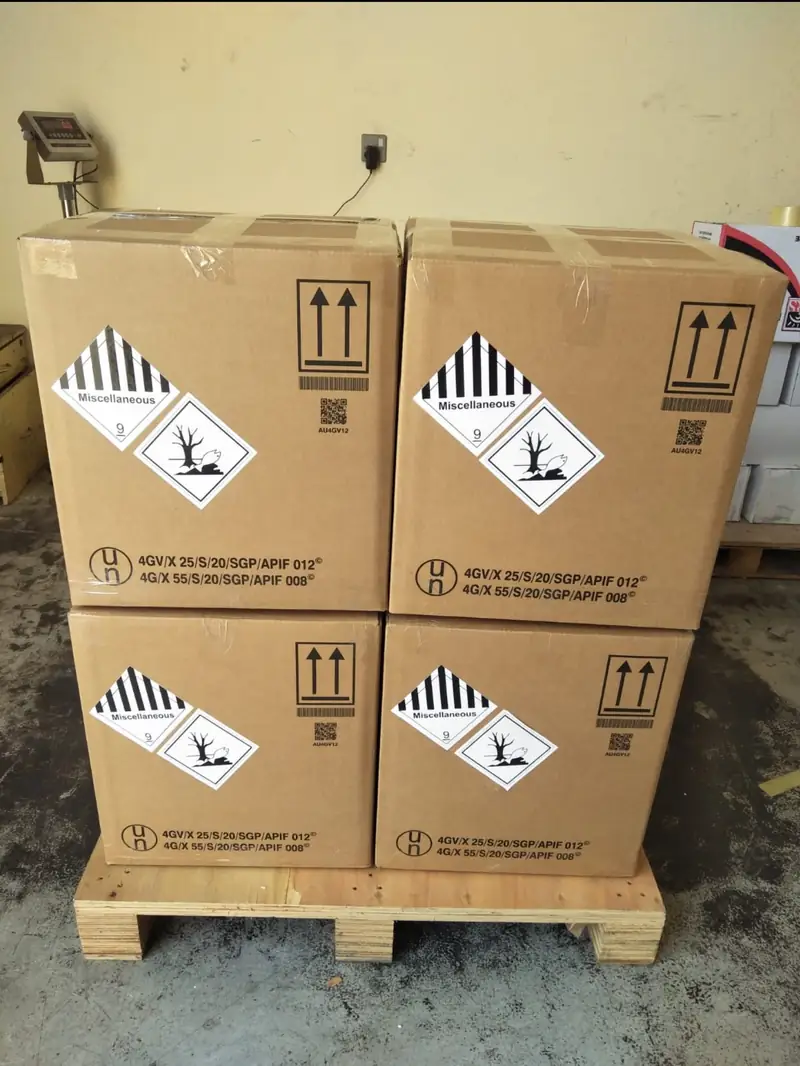
The Class 9A lithium battery label for fully regulated cargo, or the lithium battery mark for smaller shipments, on UN-specification packaging.
- 05
Batteries shipped alone (UN3480, UN3090) fly only on cargo aircraft, so the airline choice matters.
- 06
Damaged, defective or recalled batteries are forbidden by air under Special Provision A154. Road or sea may be possible.
Check your watt-hour rating
The watt-hour (Wh) figure decides which rules apply. If it is not printed on the battery, multiply the voltage by the amp-hours.
A guide, not a classification. The final check uses your safety data sheet, the UN 38.3 test summary and the airline's own rules.
Documents for shipping lithium batteries internationally
Send these with your enquiry and we can confirm the route, airline and packing the same day in most cases.
| Document | Who provides it | Why it is needed |
|---|---|---|
| UN 38.3 test summary | Battery or product manufacturer | Proves the cell and battery type passed UN testing |
| Safety data sheet (SDS) | Manufacturer | Section 14 gives the UN number and transport class |
| Shipper's Declaration for Dangerous Goods | Shipper, prepared with our help | Required for fully regulated (Section I) shipments |
| Commercial invoice and packing list | Shipper | Customs, and a check of quantity per package |
| Air waybill | Airlift Logistics | Carries the battery handling statement for the airline |
Lithium battery shipping questions, answered
Last updated ·
See all shipping questionsAsk about my batteriesYes, lithium batteries can be shipped by air from Dubai. They must meet the IATA Dangerous Goods Regulations for their UN number and packing instruction. Batteries shipped alone travel only on cargo aircraft at 30% charge or less. Batteries inside or packed with equipment can often use passenger aircraft within quantity limits.
- Each battery type needs a UN 38.3 test summary.
- Damaged or recalled batteries cannot fly.
UN3480 covers lithium ion batteries shipped on their own. UN3481 covers lithium ion batteries packed with equipment or contained in equipment, such as laptops and phones. UN3480 is forbidden on passenger aircraft and must be at 30% charge or less. UN3481 has different packing instructions, PI 966 and PI 967, and wider aircraft options.
- Lithium metal batteries use UN3090 and UN3091.
- The SDS section 14 shows the right number.
The 30% charge limit now covers batteries packed with equipment. From 1 January 2026, the IATA DGR 67th edition makes this limit mandatory for lithium ion batteries packed with equipment under PI 966. Before 2026 it was only a recommendation for them. It already applied to lithium ion batteries shipped alone under UN3480.
- Airlines may add their own stricter rules.
- Check operator variations before booking.
You need a UN 38.3 test summary and a safety data sheet. Fully regulated shipments also need a Shipper's Declaration for Dangerous Goods, and every shipment needs a commercial invoice, packing list and air waybill. The test summary comes from the manufacturer. Airlift Logistics checks the documents and prepares the declaration with you.
- Smaller Section II shipments do not need a declaration.
- The air waybill carries the battery handling statement.