
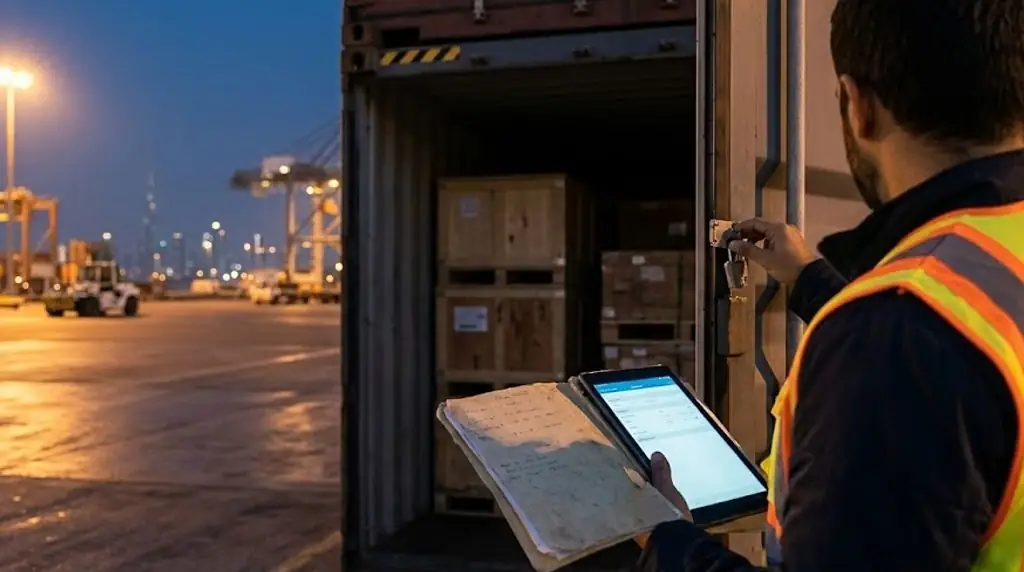
Bill of lading explainedBill of lading, explained simply.
A bill of lading (B/L) is the document a shipping line or forwarder issues for sea cargo: a receipt for the goods, evidence of the contract of carriage and, in negotiable form, a document of title. Airlift Logistics, a freight forwarder in Dubai, explains the main B/L types, what each field means, and how release works at Jebel Ali with originals, telex release or a seaway bill.
What a B/L does
One document, three legal functions. That is why banks and buyers care about it.
- 01
Receipt for the goods
The carrier confirms what it received: packages, weight and apparent condition.
- 02
Evidence of the contract
It records the terms of carriage between shipper and carrier.
- 03
A negotiable B/L lets its holder claim the goods, or transfer them by endorsement.
Types of bill of lading
The type decides who can collect the cargo, and how.
| Type | What it means |
|---|---|
| Straight B/L | Names one consignee; not negotiable |
| Order B/L | Made out "to order"; transferred by endorsement |
| Master B/L | Issued by the shipping line to the forwarder |
| House B/L | Issued by the forwarder to the actual shipper |
| Seaway bill | Not a document of title; no original needed at destination |
| Telex release | Originals surrendered at origin; cargo released by message |
| Switch B/L | Replacement set, for example in a trading chain |
| Electronic B/L (eBL) | Digital B/L on an approved platform |
The fields on a B/L
Check every field before the B/L is issued. Corrections afterwards cost time and money.
| Field | What to check |
|---|---|
| Shipper | The exporter, exactly as on the invoice |
| Consignee | Named party, or "to order" for a negotiable B/L |
| Notify party | Who the line tells when the ship arrives |
| Vessel and voyage | The ship and its voyage number |
| Port of loading and discharge | For example Jebel Ali (AEJEA) to Mombasa |
| Container and seal numbers | Must match the actual container |
| Description, packages and weight | Must match the invoice and packing list |
| Freight prepaid or collect | Who pays the ocean freight |
| Number of originals | Usually three; all must be surrendered |
B/L, seaway bill or air waybill?
Three transport documents that are often mixed up.
| Point | Negotiable B/L | Seaway bill | Air waybill |
|---|---|---|---|
| Mode | Sea | Sea | Air |
| Document of title | Yes | No | No |
| Originals needed to collect | Yes, one full set | No | No |
| Good for | Letters of credit, sales in transit | Trusted buyers, group companies | All air cargo |
| Release speed | Slowest, originals travel | Fast | Fast |
Rules on carrier liability for sea cargo come from conventions such as the Hague-Visby Rules, which many trading nations apply.
Bill of lading questions, answered
Last updated ·
See all shipping questionsAsk a freight questionIt is a receipt, a contract record and a title document. It confirms what the carrier received, records the terms of carriage, and, in negotiable form, lets the holder claim the goods. The title function is why banks use it in letters of credit and why originals matter.
- Seaway bills are not title documents.
- Air waybills are not either.
The issuer and the parties are different. The shipping line issues the master B/L to the freight forwarder. The forwarder then issues its own house B/L to the actual shipper, naming the real buyer. At destination, both must be released before the cargo can be collected.
- Forwarders acting as NVOCCs issue house B/Ls.
- Details must match both documents.
It lets cargo be released without original B/Ls. The shipper hands the originals back to the shipping line at origin, and the line tells its destination office to release the cargo to the consignee. It saves couriering time, but the shipper loses control of the goods once originals are surrendered.
- Freight must usually be paid first.
- A seaway bill avoids originals entirely.
Yes, where the law recognises it. Countries that adopt the UNCITRAL Model Law on Electronic Transferable Records, or similar laws such as the UK Electronic Trade Documents Act 2023, give eBLs the same effect as paper. Carriers use approved platforms. Check that both ends of your trade accept them.
- Banks are adopting eBLs gradually.
- Paper originals are still common.