
How Much Does Air Cargo Cost from Dubai to Europe?
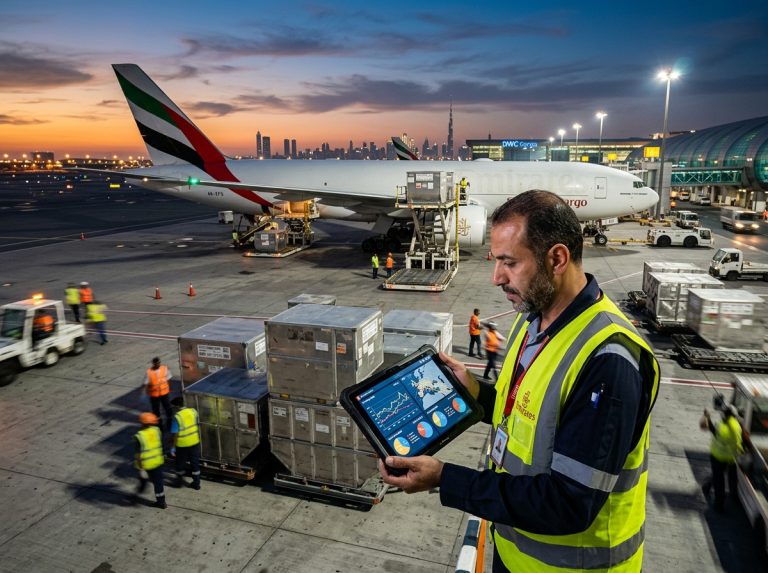
If you have ever asked a freight forwarder for a rate on air cargo from Dubai to Europe and received a number that looked reasonable – then got an invoice that looked nothing like it – you are not alone. It is one of the most common complaints among Dubai shippers, and it happens because air cargo pricing is not a single number. It is a stack of components, and most quotes only show you the base.
This guide breaks down exactly what goes into the cost of air freight from Dubai to Europe in 2026, what the real per-kg rates look like by destination and shipment type, and how to read a quote so nothing surprises you at the other end.
What Air Cargo from Dubai to Europe Actually Costs in 2026
As a working benchmark, standard air cargo rates from Dubai to Europe in 2026 range from AED 18 to AED 35 per kilogram for general cargo. That range is wide because the rate you pay depends on several factors that shift daily – destination city, chargeable weight, cargo type, urgency, and carrier availability on your specific lane.
Here is how the major European routes break down by typical rate range:
Dubai to London (LHR) – AED 20 to AED 32 per kg for standard cargo; AED 28 to AED 42 per kg for express or priority air freight
Dubai to Frankfurt (FRA) – AED 18 to AED 30 per kg for standard; AED 26 to AED 40 per kg for express
Dubai to Amsterdam (AMS) – AED 19 to AED 31 per kg for standard; AED 27 to AED 41 per kg for express
Dubai to Paris (CDG) – AED 20 to AED 33 per kg for standard; AED 28 to AED 43 per kg for express
Dubai to Milan (MXP) – AED 21 to AED 34 per kg for standard; AED 30 to AED 44 per kg for express
These are indicative market rates for 2026. Actual rates vary based on the factors covered below. Contact Airlift Logistics directly via our air cargo services in Dubai for a confirmed quote with no hidden charges.
Why the Rate You See Is Never the Rate You Pay – Unless You Ask the Right Questions
This is where most shippers get caught. A base rate of AED 20 per kg looks competitive. But air cargo costs from Dubai do not end at the base rate. Here is what typically gets added:
Fuel surcharge – this is the most significant variable add-on. In 2026, aviation fuel surcharges typically add 20 to 40 percent on top of the base rate and are revised regularly by airlines. They are tied to global jet fuel prices and can change between the time you get a quote and the time your cargo flies.
Airport security fee – mandatory at Dubai International Airport (DXB) and Al Maktoum International Airport (DWC) for all outbound cargo. Usually billed per kg and not always included in initial quotes.
Terminal handling charges (THC) – covers cargo acceptance, buildup, and loading at the origin airport. Applied at DXB or DWC and sometimes again at the destination airport in Europe.
Airway bill (AWB) fee – a flat documentation charge per shipment, typically AED 50 to AED 150 depending on the forwarder.
Customs clearance fee – if your forwarder does not handle customs in-house, this is billed separately by a third-party broker. At Airlift, customs clearance is managed internally, so it is quoted as part of the overall cost – not added later.
Airport storage – if your cargo is not collected promptly on arrival in Europe, storage fees apply. These are calculated daily and escalate quickly, especially at major hubs like LHR and FRA.
Peak season surcharge – during October through December and around major trade events, airlines apply additional capacity charges. If you are shipping electronics, fashion, or consumer goods ahead of the European holiday season, build this into your budget.
The right question to ask any freight forwarder is not “what is your rate per kg?” The right question is “what is the all-in cost for my specific shipment including fuel surcharge, THC, AWB, and customs clearance?”
Chargeable Weight: The Number That Changes Everything
Before any rate applies, the airline needs to know your chargeable weight. This is not simply how heavy your cargo is. Airlines charge based on whichever is higher – actual gross weight or volumetric weight.
Volumetric weight is calculated as: length (cm) x width (cm) x height (cm) divided by 6,000.
A practical example: you are shipping 100 kg of packaging materials from Dubai to London. The boxes measure 120 x 80 x 100 cm each and you have 10 boxes. The volumetric weight of each box is 120 x 80 x 100 divided by 6,000 = 160 kg per box. Total volumetric weight across 10 boxes = 1,600 kg. Your actual weight is 100 kg. You will be billed on 1,600 kg.
This is the most common source of invoice shock among shippers who are new to air freight from Dubai. We calculate chargeable weight before confirming any quote so the number you see upfront is the number you pay.
How Shipment Volume Affects Your Rate
Air cargo pricing is not flat. Rates drop meaningfully as volume increases because airlines and freight forwarders work with weight break pricing:
Under 45 kg – highest rate per kg; typically retail or spot pricing
45 kg to 100 kg – moderate reduction; still considered low volume
100 kg to 300 kg – rate begins to move in the shipper’s favour
300 kg and above – significant reduction; bulk rates apply and consolidation options become available
If your shipment to Europe is under 100 kg and cost is a concern, consolidated air freight – where your cargo shares space with other shippers’ goods on the same flight – brings the per-kg rate down considerably while maintaining a reliable transit window.
Transit Times: Dubai to Europe by Air
Transit time is the other half of the cost equation. Faster services cost more; understanding the difference helps you choose the right level for each shipment.
Standard air freight from Dubai to major European cities typically takes 3 to 5 business days door to door, including customs clearance at both ends.
Express air freight or next-flight-out services deliver in 1 to 2 business days on most routes. This is the option for production-critical parts, pharmaceutical shipments with tight cold chain requirements, or perishable goods with a short shelf window.
Consolidated services take 5 to 7 business days depending on consolidation schedules and are the most cost-effective option for non-urgent general cargo.
Special Cargo and What It Costs More
Certain cargo types attract premium handling charges over and above standard rates:
Dangerous goods (DG) – IATA DGR-classified shipments require additional documentation, DG declaration forms, MSDS, and approved packaging. Handling charges are higher and not all carriers accept all DG classes. Airlift manages DG shipments in-house with full IATA Dangerous Goods Regulations compliance. See airlift-logistics.com/dangerous-goods-handling/ for full details.
Temperature-controlled cargo – pharmaceuticals, perishables, and food products requiring cold chain integrity attract premium handling at both DXB and European destination airports. Active and passive temperature control options have different cost structures depending on the required temperature range and transit duration.
High-value cargo – electronics, jewellery, and luxury goods require enhanced security handling and higher cargo insurance premiums.
Oversized or out-of-gauge cargo – items that do not fit standard pallet configurations need special buildup and may require an air charter rather than belly or freighter space on a scheduled service.
Air Cargo vs Sea Freight to Europe: When Air Wins
The cost difference between air cargo from Dubai to Europe and sea freight on the same lane is significant. Sea freight from Dubai to a major European port typically costs AED 2 to AED 6 per kg for general cargo but takes 18 to 28 days transit time. Air freight costs 5 to 10 times more per kg but delivers in 3 to 5 days.
Air wins when: your cargo is time-critical; the goods are high-value relative to their weight; you are shipping perishables or temperature-sensitive items; or the cost of delay (stock-outs, production stoppages, missed retail windows) exceeds the premium of air freight.
Sea freight wins when: shipment size is large; timelines are flexible; cargo is bulk or heavy industrial goods where the weight-to-value ratio makes air cost-prohibitive.
Airlift Logistics is a leading international logistics and shipping company based in Dubai, managing air, sea, and land freight under one roof.
For multimodal shipments – where sea freight makes sense for part of the route and air for the final leg – see our sea freight services at airlift-logistics.com/sea-freight/ and land freight options at airlift-logistics.com/trucking-service/
What 2026 Market Conditions Mean for Dubai to Europe Air Cargo Rates
Rates on the Dubai to Europe air freight corridor in 2026 are elevated compared to pre-pandemic levels and have been subject to additional volatility from regional disruptions affecting Middle East airspace capacity. Aviation fuel surcharges have been running at the higher end of their historical range. Shippers with regular European volumes are better served locking in forward rate agreements with a freight forwarder rather than booking spot each time.
Peak season surcharges for the October to December period typically begin applying in September. If you are planning European shipments ahead of the holiday quarter, booking capacity early gives you better rates and avoids the capacity squeeze that hits during Q4.
If your cargo requires warehousing in Dubai before or after a flight, short and long-term options are available at airlift-logistics.com/warehousing/
How to Get an Accurate Air Cargo Quote from Dubai to Europe
When you contact Airlift Logistics for a quote, have the following ready:
Cargo dimensions per piece (length, width, height in cm); actual gross weight in kg; commodity type and HS code if known; origin point (your warehouse or free zone in Dubai); destination city and whether you need door-to-door or airport-to-airport; required delivery date or transit preference; whether the cargo is DG-classified, temperature-sensitive, or high-value.
With these details we confirm your chargeable weight, recommend the right service level, and issue an all-in quote covering base rate, fuel surcharge, THC, AWB, and in-house customs clearance. No line items appear on your final invoice that were not on your quote.
Frequently Asked Questions
What is the average cost of air cargo from Dubai to Europe per kg?
In 2026, standard air cargo from Dubai to Europe ranges from AED 18 to AED 35 per kg depending on destination, volume, and cargo type. Express services range from AED 26 to AED 44 per kg. All-in costs including fuel surcharge, THC, and customs clearance will be higher than the base rate alone.
How long does air freight from Dubai to Europe take?
Standard air freight from Dubai to major European cities takes 3 to 5 business days door to door. Express or next-flight-out services deliver in 1 to 2 business days. Consolidated services take 5 to 7 business days.
Why is my air freight invoice higher than the quoted rate?
The most common reasons are chargeable weight being higher than expected due to volumetric weight calculation, fuel surcharges applied separately, and terminal handling charges or airport storage not included in the initial quote. At Airlift, all these are stated upfront.
Can you ship dangerous goods by air from Dubai to Europe?
Yes. Airlift handles IATA DGR-compliant dangerous goods shipments to Europe with full documentation and approved carrier acceptance. Details at airlift-logistics.com/dangerous-goods-handling/
Is air freight from Dubai to Europe cheaper in certain seasons?
Yes. Rates are generally lower between January and August outside of major trade events. Peak season surcharges apply from September through December. Booking capacity early on a fixed-volume basis gives you better rates year-round.